For the past month I've been using this bogu set exclusively.
From regular dojo practice, high-level company keiko, national championship winning university training to summer gasshuku. I feel like I have really put this set of bogu through the mill.
 |
| All Japan Pitch - "Guardian" Bogu set (Dou is my own.) |
When looking for new bogu for intensive practice, I spoke to Andy at Team AJB. I told him I was expecting to use the bogu more than 4 times a week. I'd be using it at my regular dojo and out and about and different practices around Tokyo.
Andy suggested I try out Guardian, AJB's current "protective" bogu set. The bogu has a more solid construction than the more shiai oriented jissen-gata gear.
Featuring extra padding in key protective zones and wider stitching, the futon is thicker and more cushioned adding an extra layer of protection.
Its designed as a set for those who often act as motodachi, or for first time bogu buyers who are concerned about painful strikes.
This is the description of the bogu from the
All Japan Budogu product page. (click)
Guardian has been especially designed to give and extra element of protection. Using new, lightweight materials, we have increased the padding in the ares that are frequently struck with the shinai.
Does it live up to it's billing as a protective bogu set? Read on to find out.
Last week's post on fire tape was so well received that I thought I would share another taping method with you this week.
This is a trick I picked up the first time I represented Ireland, at the 2010 European Kendo Championship in Hungary.
During warm up practice I got a large blister on my foot. One of my team mates very kindly showed me this method for taping the ball of the foot. I've used it ever since!
|
|
Finished! This is a really good tape job
|
What makes this method worth sharing? Keep reading to find out!
In this post I will show you how to make a super adhesive patch using the fire tape method. This can be used to cover a blister or cut on your foot to help you continue to train.
I learned this method in my first year in Japan from a high school student in the first town I lived in.
He practiced twice a day, at his school and in the local Budokan, and as a result was well used to taping up blisters and other kendo related wounds.
I have had a problem on my right foot since that first year in Japan, I have a small re-occurring cut on the ball of my foot caused by dry feet and fumikomi. In order to continue training I usually keep a bit of this elastic adhesive tape around.
 |
| Johnson & Johnson ELASTIKON tape. You can use any brand of tape, but it must be stretchy, bandage like and adhesive. |
 |
| Close up of the tape fabric |
Below I'll show you how to make fire tape patch. Continue reading after the break!
In this post I will talk about the kendo practice at one of Japan's top Kendo schools. Nippon Sports Science University,
稽古@日体大剣道部
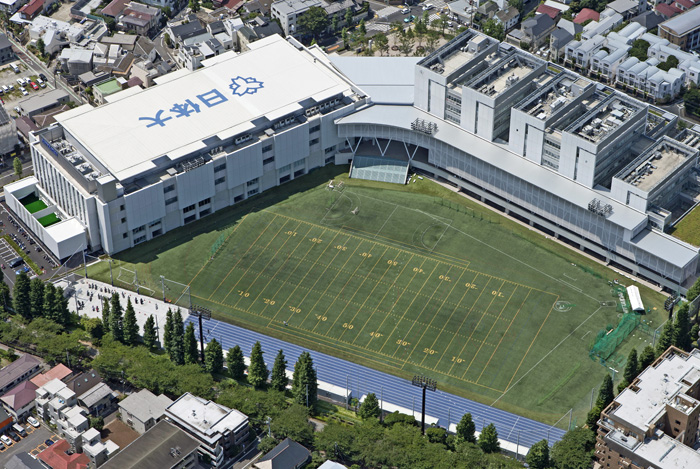 |
| Nippon Sports Science University. |
I have been lucky enough to receive permission to practice regularly at one of Japan's elite kendo institutions. Through my Sempai and his Sensei I will now be able to boost my preparation for the World Kendo Championship 2015 in Japan by joining the pratice at Nippon Sports Science University,
Nittaidai in Japanese.
After the break I will introduce the regular practice program and hopefully the following will give you an insight into how kendo is practiced at elite kendo schools, and what it is that sets it apart from other dojo in Japan and elsewhere.


